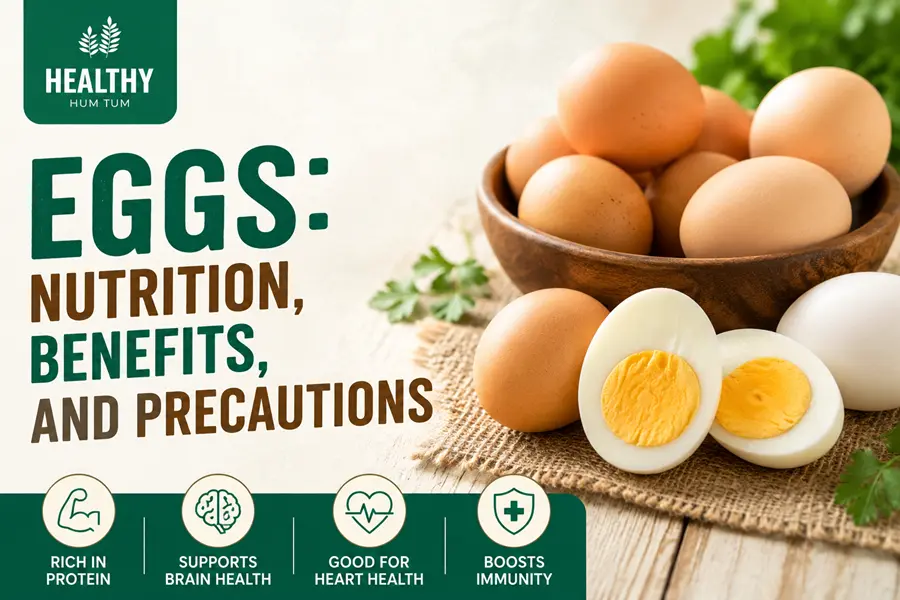
Scrambled for breakfast, hard-boiled for lunch, or in our favorite dessert recipes – the egg is one of the most popular and most consumed foods we eat universally, regardless of the region or culture. Though people eat eggs of other birds too, like quail and duck, chicken eggs are the dominant variety, and it’s the type people usually refer to whenever they talk about eggs.
So, we are going to discuss only chicken eggs in this article, and their nutritional value, health benefits, and some precautions you must take if you’re an egg lover.
Table of Contents
Nutritional Value of Eggs
An egg has mainly two parts – the white and the yolk. The white contains only 17 calories of pure protein, and there’s no fat or carbs, but there’s no vitamins or minerals either. For people who are looking to lose weight, it can save a few calories if they eat the white part only because it’s markedly lower in calories.

The yolk has more than three times the calories as well as 5 grams of fat, 185 milligrams of dietary cholesterol, and other micronutrients. Following is the complete nutritional composition of a whole egg, along with the daily required value for each nutrient –
| Nutrient | Amount in 1 Whole Egg | Approx. Adult Daily Value (DV) | % Daily Value (Approx.) |
|---|---|---|---|
| Protein | 6 g | 50 g | 12% |
| Total Fat | 5 g | 78 g | 6% |
| Saturated Fat | 1.5 g | 20 g | 8% |
| Cholesterol | 185 mg | 300 mg | 62% |
| Vitamin A | 80 mcg | 900 mcg | 9% |
| Vitamin D | 1 mcg | 20 mcg | 5% |
| Vitamin B12 | 0.2 mcg | 2.4 mcg | 8% |
| Riboflavin (Vitamin B2) | 0.2 mg | 1.3 mg | 15% |
| Phosphorus | 99 mg | 1,250 mg | 8% |
| Choline | 150 mg | 550 mg | 27% |
| Biotin | 11 mcg | 30 mcg | 37% |
| Selenium | 15 mcg | 55 mcg | 27% |
| Iodine | 28 mcg | 150 mcg | 19% |
Health benefits of eggs
Eggs are a complete food with almost every kind of nutrient your body requires every day to function properly, except for carbohydrates and sugar, which makes it even healthier.
- Provides the highest quality protein: Protein is made from various amino acids, of which nine are considered to be “essential.” What that means is our body is unable to make them on its own; we must supply these nine essential amino acids from outside, and therefore it’s crucial that we choose a diet that contains all of them. If your food doesn’t provide even one of them, the usual functions of your body may be hampered. When we say high-quality protein, it means that the protein consists of all these 9 essential amino acids with the exact pattern our body needs. The egg has 93.8% biological value, which is one of the highest among any other common food.
For example, if biological values are considered, milk has 84.5%, beef has 74.3%, and fish offers 76%. So it’s clearly seen that eggs offer us the highest quality protein content we can get from other usual foods. One thing to be noted here, though – the biological value of human breast milk is even higher than eggs.
- A must for muscle building: Protein is the main nutrient for building muscles. For gym-going people, pre- and post-exercise protein intake is a must for muscle recovery and growth. And if the protein is high-quality, the benefit will be maximum as our body will be able to absorb the same faster than other types of protein.
Also Read: What Happens When You Start Exercising Regularly?
In fact, many dieticians recommend egg protein instead of so-called packaged protein powder as an egg comes from 100% natural source without any added chemicals and provides the highest quality protein one can get.
- Brain function improvement: Egg yolk contains Lecithin, which is a healthy fat our body needs for several reasons. One of the elements of this fat is choline, and this is a nutrient linked with better neural functions. It is believed to improve our memory and learning skills.
Pregnant women should consume an adequate amount of choline for the proper brain development of the newborn. Egg’s choline and vitamin B12 together aid in preventing the formation of homocysteine, which is a primary marker for Alzheimer’s disease.
Precautions
Although there can’t be any major cons, you should take some precautions, which are as follows-
- Salmonella infection: Raw eggs can have Salmonella, which is a bacterium, and if infected, there can be fatal consequences. You must never consume uncooked eggs – always cook them well with proper heat before you eat them.
- Increased Protein level: While protein is an essential nutrient for our body, an excess amount of the same can have an adverse effect on our organs, especially the kidneys. When protein gets metabolized, it creates a chemical named ammonia, and if its level increases, it can be deadly. Your kidneys are responsible for processing and flushing ammonia out of your body, and usually, healthy kidneys do their job well. However, in case your kidney functions get impaired, and they don’t work properly, your body won’t be able to get rid of ammonia, which can cause an increased ammonia level eventually. If you have any kidney disease, talk to your physician to know how many eggs you can consume, as the egg provides lots of protein, which can take a toll on diseased kidneys.
Also Read: Almonds vs Peanuts – Which One Is Healthier